Grant: Support of Diverse Participation in the 2024 HamSCI Workshop
Date: November 2023
Amount: $35,040
Since 2018, the Ham Radio Science Citizen Investigation (HamSCI) Workshop has occurred each year, uniting the amateur radio and the professional space science communities. This workshop has been significant to many projects, including, but not limited to, the HamSCI Personal Space Weather Station Project. This workshop has a crucial role in not only the scientific workforce but also in the amateur radio community, bringing together scientists, engineers, and amateur radio operators to a place where they can both learn from each other and share ideas.
This grant will provide funding to support diverse participation at the HamSCI workshop, a two-day event to be held at Case Western Reserve University from March 22 – 23, 2024. Committed to diversity and equity, HamSCI has a track record of inviting and incorporating speakers and participants from underrepresented groups in science and engineering, where they have been the Workshop’s previous Keynote Speakers, Invited Tutorial Speakers, and members of the Science/Program committee. HamSCI will send the meeting announcement and call for abstracts to multiple organizations that serve and/or have access to members of underrepresented groups, such as the Society of Women Engineers (SWE); the American Indian Science and Engineering Society (AISES); the National Society of Black Engineers (NSBE); and HandiHams, among many others. Grant funds are expected to support a minimum of 31 local participants and 15 non-local participants. All of the above support will help to ensure an increased participation at the in-person meeting from people from underrepresented groups; students from middle school to graduate school; and active members of the amateur radio community.
Learn more at https://hamsci.org/hamsci2024.
Update
The Ham Radio Science Citizen Investigation (HamSCI) Workshop 2024 was held at Eldred Hall on the campus of Case Western Reserve University (CWRU), in collaboration with The University of Scranton, from Friday 22nd to Saturday 23rd March. Over the course of two days, the workshop brought together professional scientists and amateur radio operators for oral and poster presentations, equipment demonstrations, and informal discussions. The event fostered collaboration and networking across the amateur radio community and related scientific disciplines.
Funding from the ARDC grant was primarily allocated to increase diversity and broaden participation among in-person attendees by supporting participant expenses, including airfare, accommodation, and subsistence. Specifically, the funding supported 15 non-local participants, covering round-trip airfare and/or ground transportation, three nights of hotel accommodation, and travel-day per diem. Furthermore, the grant also covered conference materials and supplies, publication costs including documentation and distribution, poster printing, associated computing resources such as hardware, software, and computational infrastructure used for workshop activities and also included a small gift for all attendees. The funding additionally supported catering and meals cost for 46 fully funded participants (31 local and 15 non-local) and 48 subsidized participants.
The workshop was attended by nearly 120 in-person participants, with another 125 additional attendees participating virtually via Zoom. The Friday keynote was given by Dr. Scott McIntosh, deputy director of the National Center for Atmospheric Research and focused on new research for predicting and understanding the duration and strength of solar cycles. Saturday invited speakers were Dr. Katie Zawdie of the Naval Research Laboratory, who gave a tutorial on ray tracing for understanding high frequency ionospheric radio propagation, and Phil Karn, KA9Q, who spoke about the KA9Q-radio SDR package.
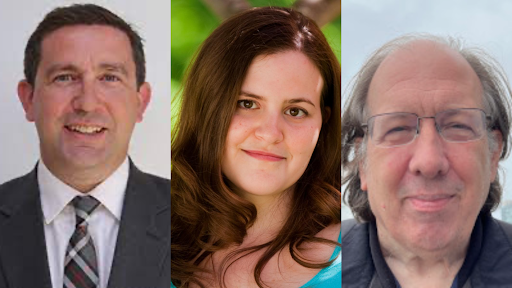
HamSCI Workshop 2024 Keynote and Invited Speakers, L to R: Dr. Scott McIntosh, Deputy Director, National Center for Atmospheric Research; Dr. Kate Zawdie, Research Physicist, US Naval Research Laboratory; Phil Karn KA9Q, KA9Q Software Defined Radio system.
The funding also enabled broad collegiate and youth participation from programs such as Youth on the Air (YOTA) and multiple universities, including the University of Scranton, New Jersey Institute of Technology, University of Arizona, Case Western Reserve University, and Virginia Tech, involving several dozen students. The ARRL also sent its representative from its Collegiate Amateur Radio Program (CARP) to attend the workshop recognizing this strong collegiate engagement. HamSCI hosted a dedicated CARP forum on university amateur radio activities during the event.
Overall, the ARDC grant successfully expanded diverse participation, fostering professional development. It also increased the visibility of collegiate amateur radio programs and strengthened connections between academic institutions, youth programs, and the broader scientific community, resulting in sustained engagement beyond the workshop itself.
More information can be obtained from https://hamsci.org/hamsci2024.
YouTube playlist of talks: https://www.youtube.com/playlist?list=PLs_Ab58w9LI80bQrC0m5Nl5p3UTEv9Nug.